





Amy J. C. Cuddy
- Media Contact
- SPN Mentor
Amy J. C. Cuddy is an Associate Professor in the Negotiation, Organizations & Markets Unit at the Harvard Business School. She holds a Ph.D. in Psychology from Princeton University and B.A. in Psychology from the University of Colorado.
Professor Cuddy studies the origins and outcomes of how we perceive and are influenced by other people, investigating the roles of variables such as culture, emotions, nonverbal behaviors, and psychophysiological indicators. Much of her work focuses on social categories (e.g., Asian Americans, elderly people, Latinos, working mothers) – how they are judged by others and by their own members (i.e., stereotyping), and how these judgments set the tone and content of social interactions (i.e., prejudice and discrimination).
Cuddy and her collaborators have developed a substantial body of research that focuses on judgments of other people and groups along two core trait dimensions, warmth and competence, which shape and motivate our social emotions, intentions, and behaviors. She examines how these social perception and influence processes play out in domains such as hiring, promotion, and charitable giving. Her research has been published in top academic journals, including Science, the Journal of Personality and Social Psychology, Trends in Cognitive Sciences, and Advances in Experimental Social Psychology. In 2008, she received the Alexander Early Career Award from the Society for the Psychological Study of Social Issues.
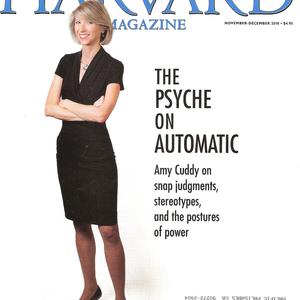
Her research has been covered on CNN, MSNBC, by the New York Times, Financial Times, Boston Globe, and the Wall Street Journal, among other news outlets. Her research was also featured in Harvard Business Review's Breakthrough Ideas for 2009 ("Just because I'm nice, don't assume I'm dumb"), Scientific American Mind in 2010 ("Mixed impressions: How we judge others on multiple levels"), and as the cover story in the Nov-Dec 2010 issue of Harvard Magazine ("The Psyche on Automatic").
Primary Interests:
- Culture and Ethnicity
- Emotion, Mood, Affect
- Gender Psychology
- Helping, Prosocial Behavior
- Intergroup Relations
- Interpersonal Processes
- Neuroscience, Psychophysiology
- Nonverbal Behavior
- Person Perception
- Prejudice and Stereotyping
Note from the Network: The holder of this profile has certified having all necessary rights, licenses, and authorization to post the files listed below. Visitors are welcome to copy or use any files for noncommercial or journalistic purposes provided they credit the profile holder and cite this page as the source.

Video Gallery

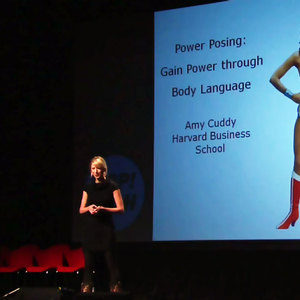
Your Body Language May Shape Who You Are (TED talk)
Select video to watch
-
21:03 Your Body Language May Shape Who You Are (TED talk)
Length: 21:03
-
17:25 Power Posing: Gain Power Through Body Language
Length: 17:25
-
1:41:44 How to Develop Massive Confidence
Length: 1:41:44
-
1:08:29 Presence: Bringing Your Boldest Self to Your Biggest Challenges
Length: 1:08:29
-
1:13:49 On Presence (92nd Street Y, New York)
Length: 1:13:49
-
3:32 Turning the Power Back On (NOVA)
Length: 3:32
-
7:07 How Your Posture Impacts the Mind (CBS Mornings)
Length: 7:07
-
5:11 Feeling Anxious? The Last Thing You Should Do Is Lie to Yourself
Length: 5:11
-
1:43 Interview Tips (Stylist Magazine)
Length: 1:43
-
2:15 Tips for Successful Public Speaking
Length: 2:15
-
58:39 Power Posing: How the Body Changes the Mind
Length: 58:39
-
20:48 Power, Expansiveness, and Gender
Length: 20:48
-
2:46 How Body Language Can Change Your Future
Length: 2:46
-
1:58 How to Become a Powerful Public Speaker
Length: 1:58
-
4:09 "Five Questions With..." Interview
Length: 4:09
Books:
Journal Articles:
- Carney, D., Cuddy, A. J. C., & Yap, A. (2010). Power posing: Brief nonverbal displays affect neuroendocrine levels and risk tolerance. Psychological Science, 1363-1368.
- Carney, R., Cuddy, A. J. C., & Yap, A. J. (2015). Review and summary of research on the embodied effects of expansive (vs. contractive) nonverbal displays. Psychological Science 26(5), 657-663.
- Cuddy, A. J. C. (2009). Just because I'm nice, don't assume I'm dumb. Harvard Business Review, 87, 24.
- Cuddy, A. J. C., Fiske, S. T., & Glick, P. (2007). The BIAS Map: Behaviors from intergroup affect and stereotypes. Journal of Personality and Social Psychology, 92, 631-648.
- Cuddy, A. J. C., Fiske, S. T., & Glick, P. (2004). When professionals become mothers, warmth doesn't cut the ice. Journal of Social Issues, 60, 701-718.
- Cuddy, A. J. C., Fiske, S. T., & Glick, P. (2008). Warmth and competence as universal dimensions of social perception: The Stereotype Content Model and the BIAS Map. In M. P. Zanna (Ed.), Advances in Experimental Social Psychology (Vol. 40, pp. 61-149). New York: Academic Press.
- Cuddy, A. J. C., Fiske, S. T., Kwan, V. S. Y., Glick, P., Demoulin, S., Leyens, J. Ph., Bond, M. H. et al. (2009). Stereotype content model across cultures: Towards universal similarities and some differences. British Journal of Social Psychology, 48, 1-33.
- Cuddy, A. J. C., Norton, M. I., & Fiske, S. T. (2005). This old stereotype: The pervasiveness and persistence of the elderly stereotype. Journal of Social Issues, 61, 265-283.
- Cuddy, A. J. C., Rock, M., & Norton, M. I. (2007). Aid in the aftermath of Hurricane Katrina: Inferences of secondary emotions and intergroup helping. Group Processes and Intergroup Relations, 10, 107-118.
- Cuddy, A. J. C., Wilmuth, C. A., Yap, A. J., & Carney, D R. (2015). Preparatory power posing affects nonverbal presence and job interview outcomes. Journal of Applied Psychology 100(4), 1286-1295.
- Fiske, S. T., Cuddy, A. J. C., & Glick, P. (2007). Universal dimensions of social cognition: Warmth and competence. Trends in Cognitive Sciences, 11, 77-83.
- Fiske, S. T., Cuddy, A. J. C., Glick, P., & Xu, J. (2002). A model of (often mixed) stereotype content: Competence and warmth respectively follow from perceived status and competition. Journal of Personality and Social Psychology, 82, 878-902.
- Fiske, S. T., Harris, L. T., & Cuddy, A. J. C. (2004). Why ordinary people torture enemy prisoners. Science, 306, 1482-1483.
- Fiske, S. T., Xu, J., Cuddy, A. J. C., & Glick, P. (1999). (Dis)respecting versus (dis)liking: Status and interdependence predict ambivalent stereotypes of competence and warmth. Journal of Social Issues, 55, 473-490.
- Frantz, C. M., Cuddy, A. J. C., Burnett, M., Ray, H., & Hart, A. (2004). A threat in the computer: The race Implicit Association Test as a stereotype threat experience. Personality and Social Psychology Bulletin, 30, 1611-1624.
- Maddux, W. W., Galinsky, A., Cuddy, A. J. C., & Polifroni, M. (2008). When being a model minority is good... and bad: Realistic threat explains negativity toward Asian Americans. Personality and Social Psychology Bulletin, 34, 74-89.
Other Publications:
Courses Taught:
- Leadership in Organizations
- Negotiations
- Power and Influence
- Research Methods
- Social Psychology
Amy J. C. Cuddy
Harvard Business School
Baker Library 669
Boston, Massachusetts 02163
United States of America
